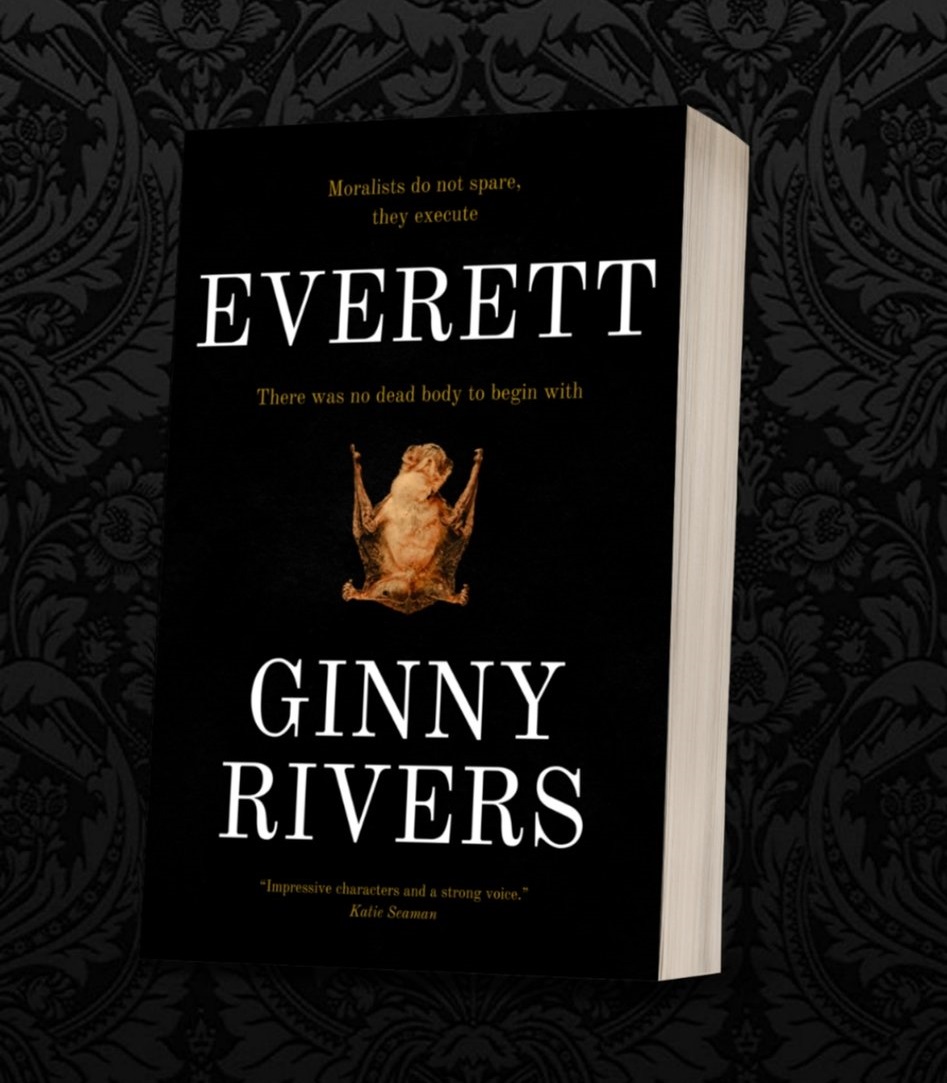
Writing this novel has been giving my mind a break. More than an analysis of Plato’s definition of a good man, Everett was shaped following the circles of Milton’s Paradise Lost and was forcibly entailed by Andrew Scull’s work on Madness in Civilization. His hypothesis showed that there are some diseases no one wants to own, and for which everyone immediately wants to blame someone else. I was immediately seduced by the theory and starting sketching characters around this thesis, with one certainty in mind: my first character had to be an unreliable narrator. There was no way around it.
And perhaps I somehow think of myself as an unreliable protagonist in my life, thus foreseeing morally grey characters in every story I write. I’ve truly tried to lay on the brighter side of life, more times than I can count and I must admit that never worked well with who I am. My stories are dark and challenging. Characteristics often criticized by editors.
« We’re sorry to share your novel was too tragic for us. »
I felt the publishing route was definitely not ready for some dark gothic critic of elitism, although similar novels had already been published at the time, or decades earlier. I guess this just wasn’t the right time for me.
I decided I should use those later years to polish my writing, get better at character building, improve my chronology. And that’s what I did.
Here I am, thirteen years later, submitting my first literary fiction, Everett, to dozens of literary agents, all interested in discovering more of the dark academia subgenre.
I know it will probably sound cliché, but I got seduced by the genre while reading Donna Tartt‘s The Secret History. She was it for me. After being overly obsessed with stream of consciousness and Virginia Woolf’s works, I dived into Donna Tartt’s psychology and found I related so much more than I thought was possible. Read all the other dark academia novels, obviously, but none was as precise and talented as TSH. I did give them a chance though. M. L. Rio’s If We Were Villains comes second in my list of favourites.
I wanted Everett to be different in a sense though. My goal was not to write a poor version of Donna Tartt’s work. I wanted to bring something new into the genre. Most brought out the race topic, which was a fabulous choice to make of course, but I guess I wanted to focus on the human condition, and self destruction, much like Dostoievsky did in his time. He was a master of his own genre.
After years and months of editing Everett, it appeared to me than it wouldn’t be just another story I’d write and throw in a drawer, piling on dust. This novel would be it, for me. I’d make sure of that.
Thus, I got an account on reedsy, and started a collaboration with Katie Seaman, who’s an editor and book coach. Working with Katie has been such a wonderful journey. Dedicated, responsive, and joyous, she’s always made me feel like my project was worth something. Katie has been patient, thorough and unquestionably kind and professional in her feedbacks. She didn’t leave anything out and pinpointed numerous advices regarding the manuscript that truly helped me get back on board with my writing plan. I couldn’t dream of a better editor to work with and will definitely come to her, should I need more help in the future. I highly recommend her, and encourage you to trust that she’ll try her best to defend your project and make it shine!
At this point, I thought editing had obviously been the tough part in writing a novel. I was wrong.
Cause here stood the query trenches, welcoming me with its two best friend: self doubt and imposter syndrome.
Getting in the trenches means you must know what you’re getting into: rejections, rejections, and more rejections.
Then, and only then, should come the glorious offer.
I’m not there yet, but I have good hopes. And I’ll definitely let you all know if anything serious happens.
But for right now, I shall be patient and focus on my TBR list, which includes Ellie Keel’s The Four, which is very similar to Everett, according to Katie.
For more gothic vibes, I’ve started M. L. Rio’s Graveyard Shift, and I must say it’s a banger! Just like the SweetPea show, which I regret not getting to read first.
Enjoy your evening, folks! And beware of the monsters. They’re most often human.
 Ginny Rivers
Laisser un commentaire